

Case Study
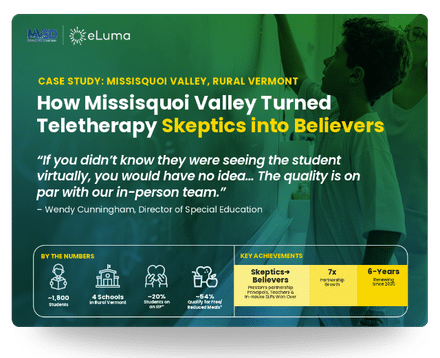
How Missisquoi Valley Turned Teletherapy Skeptics into Believers
Skeptical principals, teachers, and in-house SLPs became advocates after seeing sessions firsthand
IEP reporting on par with in-person providers, which eased parent concerns
7x partnership growth over six years, expanding from one service to four
~1,800 students across four rural schools in rural Vermont
Table of Contents
When Wendy Cunningham stepped into her role as Director of Special Education, she faced deep-rooted skepticism toward teletherapy, not just from educators, but from parents and even some administrators.
Staff referred to eLuma cautiously, sometimes as if it were a last resort. “It was almost like a dirty word,” Wendy recalls. Meanwhile, the district was grappling with severe staffing shortages.

Once supported by seven in-district speech-language pathologists (SLPs), Missisquoi Valley dropped to just three in two years due to retirements, relocations, and part-time transitions.
With hiring efforts falling flat, Wendy realized that if the district didn’t act quickly, students—especially in early childhood—would miss out on critical support, leading to an increase of compensatory services.
The Turning Point
eLuma initially stepped in to temporarily cover for an SLP on family leave, using flexible therapy services that include virtual and on-site providers. Because of the district’s needs and location, eLuma placed a virtual provider to support students in the Missisquoi Valley School District.
What began as a short-term solution quickly revealed its long-term potential. Despite the pushback, Wendy championed the partnership.
“They’d say, ‘That’s not best practice,’ and I’d ask, ‘Where are you getting that?’” Wendy said. “eLuma had been doing this for years, even before COVID.”
Wendy also made a subtle but powerful shift in language: instead of labeling the services as teletherapy, she started referring to eLuma clinicians simply as “our SLPs.” The reframing helped eliminate the “us vs. them” mindset.
Winning Over the Skeptics
One of the district’s rural elementary schools was deeply committed to its students and was among the most resistant. The principal openly voiced doubts about virtual services. But shortly into the school year, their view changed.
“I was really not happy about this,” the principal later admitted, “but it’s actually been fine and pretty great. I see kids come out of their sessions smiling.”
Teachers and in-district SLPs noticed similar outcomes. Students were progressing, and over time, in-house staff began building real relationships with their virtual colleagues. Continuity year over year helped cement that trust even more.
Real Results, Real Relationships
Parents who were once concerned started hearing more about how their children were making progress on their IEP goals.
After finishing her first virtual session, one young student took off her headphones and said, “That’s fun.”
“If you didn’t know they were seeing the student virtually, you would have no idea,” she said. “The quality of feedback and understanding of student needs is on par with our in-person team.”
Advice to Other District Leaders
Wendy’s advice to other special education directors considering teletherapy:
“Walk into the decision with confidence. Ask your principals to sit in on a session. Give it time. Once people hear it happening and see the smiles, everything shifts.”
Looking Ahead: Embracing a New Normal
As staffing shortages persist nationwide, Wendy sees teletherapy as a permanent and practical part of the future.
“This is going to be more and more the way services are delivered,” she said. “But I’m not afraid.”
Through collaboration, persistence, and trust, Missisquoi Valley turned doubt into progress and found a reliable partner in eLuma to ensure students continue to thrive.