

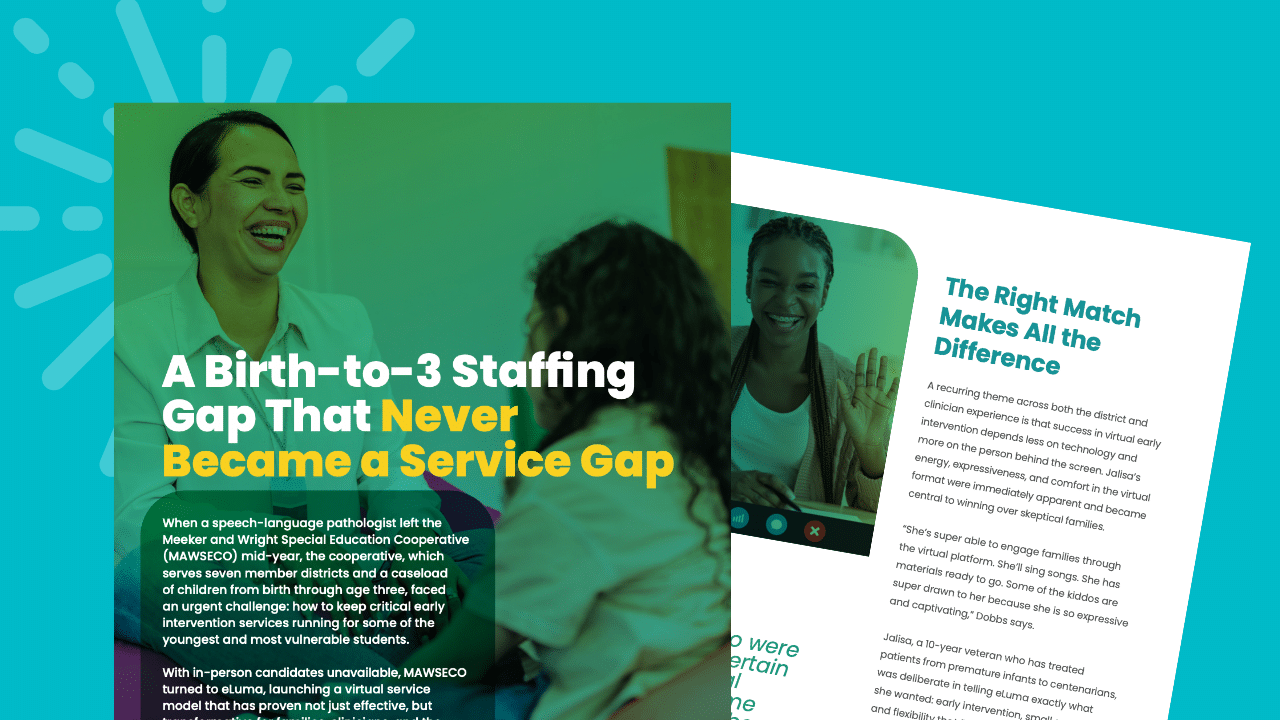
A Birth-to-3 Staffing Gap That Never Became a Service Gap
Case Study
When a speech-language pathologist left the Meeker and Wright Special Education Cooperative (MAWSECO) mid-year, the cooperative faced an urgent challenge: how to keep critical early intervention services running for children from birth through age three across seven member districts. With no in-person candidates available, MAWSECO turned to eLuma and built a virtual service model that has proven not just effective, but transformative for families, clinicians, and the cooperative alike.
About MAWSECO
The Meeker and Wright Special Education Cooperative coordinates services for seven member districts in rural central Minnesota. Its birth-to-three team includes speech-language pathologists, early childhood special education (ECSE) teachers, and district coordinators who deliver services in families’ homes.


Table of Contents
When Staffing Falls Short, Students Can't Wait
When one of the team’s three SLPs left the position, MAWSECO found itself unable to fill the role through traditional hiring. For children ages birth through three, a delay in services is not just an inconvenience. It can mean missed developmental windows that do not come back.
For Lea D., Early Childhood Coordinator for the cooperative, standing still was not an option.
“We needed something. We were left scrambling, and we’re thankful that we’re able to fill that position with the virtual services.”
Building Services from the Ground Up
MAWSECO had some prior exposure to virtual services, but nothing at the scale of a full school-year commitment. Onboarding eLuma clinician Jalisa required building a new operational model, one that could bring telehealth into the intimate, home-based world of early intervention.
A key early decision shaped everything that followed: MAWSECO committed to having an ECSE teacher physically present at every home visit alongside Jalisa’s virtual presence. This ensured that parents of infants and toddlers were never left to manage technology alone and provided a trusted in-person bridge for the virtual session.
Front-loading was critical. Lea organized a series of early meetings, first with Jalisa individually and then with the ECSE teachers as a group, to set expectations, establish communication protocols, and ensure everyone understood their roles. Shared calendars and regular texting kept the distributed team in sync.
“It was a lot of front-loading. We did a lot of meetings at the beginning. Then it slowly developed into where the team would figure out what works for them.”
The Unique Advantage of Virtual in Early Intervention
Early intervention is built around coaching parents in their natural environment, and the virtual format offered unexpected advantages for exactly this kind of work.
A Bird's-Eye View of the Home
Jalisa’s screen position gave her a wide-angle view of the family’s home, allowing her to observe dynamics that in-person providers might miss. In one session, she noticed a sibling repeatedly disrupting a child’s focus from behind, while the teacher and parent, both physically present, were unaware. Being able to name what she was seeing in real time gave the family an entirely different lens on their child’s behavior.
Capturing Natural Language Samples
The screen also allowed Jalisa to fade into the background when helpful, capturing natural language samples without influencing the child’s behavior. In one case, a parent reported a child saying only five words, but while quietly observing, Jalisa counted four additional words during natural play that the parent had not registered.
“I’m able to watch everything happening in the space. I can fade into the background and really pay attention to all of the moving parts.”
Surfacing What Intake Forms Miss
In one family, Jalisa overheard a grandmother giving directions in Spanish, information that had not surfaced in the intake paperwork, but that fundamentally shaped how the team understood the child’s language development.
Student Wins That Matter
One two-year-old arrived with roughly two words and a history of untreated ear infections. After tubes were placed and consistent virtual sessions began, he walked into a session and said unprompted: “I want doggy.” When Jalisa offered a different puppet, he replied: “No, doggy.”
“That’s language full circle, expressive, receptive, and emotional. Mom’s goal was for him to tell her what he wants. That was the family’s goal, and we got there.”
Beyond direct service, Jalisa expanded her role to include virtual evaluations and assessment support, taking on tasks previously handled entirely by the in-person SLP team. She conducted testing virtually and served in a coaching role during teacher-administered assessments, extending the team’s capacity in ways that were not originally anticipated.
Looking Forward: A Model Built to Last
For MAWSECO, the partnership with eLuma has done more than fill a vacancy. It has introduced a sustainable model built on intentional onboarding, strong team integration, and a clinician who has made herself indispensable to the families she serves.
For districts and cooperatives considering virtual services for the first time, the guidance from MAWSECO is clear: plan thoroughly, front-load the relationship, and be present in the early weeks. Build trust early, then step back as things find their rhythm.
With eLuma’s support, MAWSECO has ensured that no child in its birth-to-three program goes without communication services, and that families across seven member districts have a consistent, trusted clinician showing up for them, session after session.
Improve Student Outcomes
Partner with eLuma to remain compliant, address staffing issues and serve the needs of your students on a secure platform.