Identify the social, behavioral, and stress‑related needs of every student and turn results into support with our end‑to‑end universal screening services.
What Universal Screening Is &
How It Helps MTSS Succeed
Don’t just screen—act. Turn data into immediate support with eLuma.
Screen every student with a quick, trusted assessment so you can spot needs early, track trends over time, and match students to Tier 1, Tier 2, or Tier 3 supports. Universal screening is a standard part of MTSS, alongside ongoing progress checks and team‑based decisions.
National organizations recommend using reliable, well‑validated tools, like the SSIS™ CoLab Brief Universal Screener, and reviewing results in teams to ensure fair, data‑driven choices.
The result: You get consistent, comparable data across classrooms, schools, and years—without adding heavy lift for staff.
What You’re Screening Students with:
The SSIS Brief Universal Screener of Social & Behavioral Health
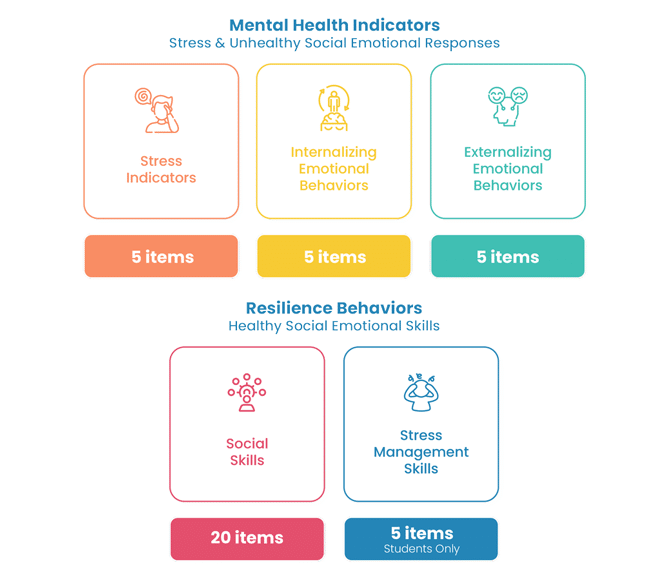
You receive a comprehensive snapshot of student well-being across three mental health indicators and resilience behaviors. Students, teachers, and families each complete a short behavior rating scale, which takes approximately 7 minutes per person. The screener works across preK–12, includes student self-report from grades 3–12, and is available in both Spanish and English, with read-aloud options to support access for all learners.
What you learn from the results An easy-to-interpret Resilience profile that highlights students’ social skills, stress‑management strengths and needs, and scoring for norm-referenced and performance-referenced comparison.
Early signs of behavioral health concerns, including “internalizing” (inward signs like anxiety or withdrawal) and “externalizing” (outward signs like acting out), so your student support team can respond quickly and appropriately.
Clear reports at the student, class, school, and district levels, plus easy data exports you can pull into your SIS or MTSS platform.
Why you can trust it The SSIS family of measures has been tested in peer-reviewed research, including a multi-country study showing strong evidence for the brief, multi-informant scales used for universal screening.
The SSIS™ Brief Universal Screener of Social & Behavioral Health is designed to screen and monitor students' capacity to be resilient and identify protective social skills needed to improve their resiliency. The assessment is brief and easy to use, and provides actionable results that can be used to guide interventions. (Source: Resonant Education)
From Screen to Support: How eLuma’s
End‑to‑End Service Works
We start by partnering with your team to set clear goals, define student groups, outline communication and consent steps, and map out timelines. Together, we create a plan that fits your school’s calendar and ensures everyone knows their role.
Throughout the year, your MTSS team reviews data at key checkpoints so results lead to real action, not just reports.
What you get: A clear roadmap and process that make universal screening manageable and meaningful. Every perspective—student, teacher, and guardian—is included to ensure equity and reduce blind spots.
We set up the SSIS Brief Universal Screener to measure Social and Behavioral Health for your students, teachers, and families, and train staff to use it confidently. Each person can complete their part in just a few minutes, keeping class time focused on learning.
What you can expect: A quick, inclusive screening process that takes about 7 minutes per person, suitable for grades K–12, available in English and Spanish, with read-aloud and accessibility options built in.
Once the screening is complete, our consultants guide your team through the results. We help you understand what the data says about resilience, social skills, and behavioral health, from individual students to school-wide trends. We also provide exports that fit neatly into your student information or MTSS systems and prepare clear, actionable lists for follow-up.
What you get: Easy-to-use reports that tell a full story, including individual and group summaries, progress over time, and ready-to-use data for your existing systems.
We help you turn results into next steps. Results from the SSIS Brief Universal Screener are aligned with the SSIS Classwide Intervention Program (CIP) for Tier 1 and CIP-T2 (for Tier 2), two proven-effective intervention programs for children in grades 1 to 12. These programs are nationally recognized and evidence-based.
When a student needs individualized care, we can provide licensed counselors, school psychologists, or clinical social workers from eLuma’s national network.
What you get: Hands-on implementation and coaching. Our experts provide training, data review meetings, and guidance to help your team translate insights into student support plans.
We don’t stop with the first screening results. We help you schedule beginning-, middle-, and end-of-year checkpoints to track progress and trends. You’ll see growth by grade level, cohort, or subgroup—not just a one-time snapshot.
What you get: Ongoing insight into student well-being and access to licensed professionals who can deliver counseling or evaluations when extra support is needed.
Why This Approach Drives Outcomes
Universal support: Early identification leads to earlier, more equitable support. SSIS brief measures are validated for efficient universal screening across raters.
Instructional alignment matters: Classwide and small‑group SSIS interventions have RCT (Randomized Controlled Trials) evidence for improving social behavior and classroom learning behaviors.
Operational efficiency: Short, standardized forms reduce staff burden while giving consistent, comparable data for MTSS decisions.
Aligned to SSIS Social & Behavioral Health Framework
Build Supportive Responsive Relationships
Manage Stress
Strengthen Core Skills to Plan & Achieve Goals
The SSIS Social & Behavioral Health framework is based on decades of research synthesized by the Center on the Developing Child at Harvard (2017; 2021) and efficacy research with the SSIS SBH Classwide Intervention Program (2020).
What's Included with eLuma's Universal Screening Services
District Kickoff and Full Implementation Plan
Screener Configuration and Rostering Support
Training for Teachers, Providers, and Administrators
BOY, MOY, and EOY Data Reviews, and Planning Sessions
Intervention Mapping to SSIS CIP and CIP‑T2 with Optional Referrals to eLuma Providers as Needed
Data Exports and Integration Support for SIS, MTSS & RtI
Available Caseload Management in Insight™, eLuma’s Student‑Services Platform, to Centralize Session Notes, Progress, and Reporting.
eLuma Success Stories
Sherry B.
Director of Special Education
Our district had an unexpected need... eluma was quick and flexible in responding to our needs. The therapist we have been provided matches our district extremely well. She quickly fit into our team and adapted to our routines. We couldn’t have found a better fit.
Kirsten U.
Director of Student Services
I've been truly happy with eLuma's service. It has been a very good experience. I can always get in touch with the therapists and my eLuma Team Lead whenever I've needed to talk to them.
Discuss Your Options with an Expert
To learn how eLuma can help your school district build an end-to-end social and behavioral health screening, assessment, and intervention program, schedule a free consultation today.